


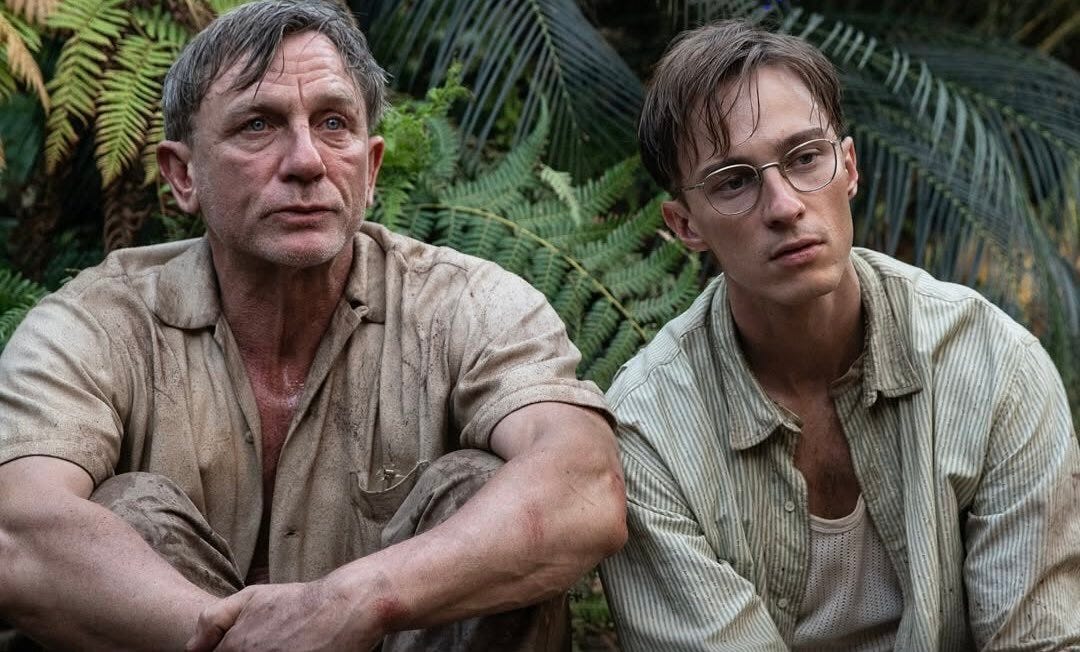
Queer simultaneously gives you the feeling of hope and unbearable loneliness, while Daniel Craig delivers an incredible performance of a man desperately longing for connection and closeness, shedding every last trace of his infamous 007 persona. Even after Knives Out, which gave us a glimpse of his range, this certainly presents him in a new light - an incredibly raw performance of a man with a desire for intimacy and love.
Queer, by Luca Guadagnino, is an adaptation of a novella by William S. Burroughs, an autobiographical self-portrait, which was written back in 1952.
We see Lee, played by Daniel Craig, an expat from America living in Mexico City. His days are filled with drinking and fleeting encounters or, more often, the yearning for them. Lee is desperate for some sort of closeness, especially as a queer man in 1950 (when the term still carried deep derogatory weight). He finally encounters Eugene, played by Drew Starkey, who’s allure completely enamours him. At this point, Eugene’s queerness is not clear. He is an enigmatic young man, exuding a hot-and-cold energy that keeps Lee in a state of emotional uncertainty. This is where we see a perfect portrayal of vulnerability, Lee is completely captivated and appears helpless. There is a real emotional authenticity that strikes you right through the screen.
Luca Guadagnino is certainly a craftsman for creating a truly cinematic experience. The cinematographer Sayombhu Mukdeeprom, who also worked on Challengers and Call Me by Your Name, brings his signature artistry, creating a rich and atmospheric world. Slow-motion scenes, dreamlike sequences, beautifully capture the intoxicated haze of Mexico City’s streets, adding to the film’s hypnotic allure.
Daniel Craig delivers a spectacular performance, fully embodying the depth of his character. While Drew Starkey is a strong choice for Eugene, it’s Craig who truly commands the screen, giving a performance that feels raw, committed, and all-consuming.
The film plays with anachronism in an almost mischievous way, weaving in music that doesn’t belong to its era yet somehow fits perfectly. Nirvana plays, nodding to Kurt Cobain’s fascination with Burroughs, perhaps even to their collaboration on The “Priest” They Called Him, where Cobain desperately sought to connect with his idol but was left with only a tape in return.
There’s also an eerie nod to Burroughs’ own tragic history: a game of William Tell, an echo of the drunken moment that led to his wife’s death. These moments of intertextuality add a haunting undercurrent, tethering the film’s themes of obsession and loss to reality in unsettling ways.
The final chapters are where I felt it started to lose its magic. As the story unfolds, Lee and Eugene embark on a journey deep into the jungle, seeking yagé, also known as ayahuasca, the supposed key to telepathic connection. For Lee, this quest is not just for enlightenment but for the impossible: a way to truly understand Eugene. We see an unrecognisable Lesley Manville,
who plays a doctor in the jungle, with unique knowledge about yagé. Aside from a strikingly immersive hallucinogenic sequence, where Guadagnino masterfully captures an intense sense of closeness, this portion of the film feels disconnected from the rest. Nevertheless, the ending was quite a tearjerker.
Final Thoughts:
Queer is intoxicating, melancholic and, at times, devastating. While its latter half may not hold the same charm as its beginning, the film remains a hypnotic meditation on desire and loneliness. Craig delivers an incredibly raw, and authentic performance, and Starkey makes for a compelling object of obsession. With its dreamlike sequences and anachronistic soundtrack, Queer is a cinematic experience that will leave a long lasting impression.
