


If after watching this film you were choked up, then join the club.
Celine Sciamma has decided that less is more and so all of the emotions are entirely just from looks and glances. There’s a raw authenticity to it all, the kind that captures real relationship dynamics: the quiet intimacy of pillow talk, the hesitant buildup to finally saying what you both feel, the internal “does she, doesn’t she?” debate that runs through your mind before and after choosing to be vulnerable. You feel the weight of their questions, their regrets, their desires. The story and performances are so sincere, so grounded, that you never once doubt their longing.
After all, it only took a glance for them to fall in love.
Womanhood/Sisterhood
As you probably noticed while watching, men are almost entirely absent from this film. They’re peripheral, like the ones who escort Marianne to the house, or those mentioned in passing: Marianne’s father, whose name she must use to exhibit her art since women weren’t allowed to do so independently, and the man Heloïse is expected to marry - a fate not originally meant for her, but for her sister. Heloïse even wonders aloud whether her sister’s final apology was for leaving her with that fate after her death.
Instead, the film centers on women: Heloïse’s mother, and of course Marianne, Heloïse, and the maid. A quiet, intimate bond forms among the three younger women as they read together, play cards, gather around a bonfire, and support the maid during her abortion. There’s a deep sense of solidarity and ease among them, women left alone, creating their own world. They laugh, share, and simply exist together, free from the gaze or interference of men.
The myth of Orpheus and Eurydice becomes a powerful parallel. It’s through this lens that we witness Marianne and Heloïse’s final goodbye. As they read the story together, each woman interprets the story differently: the maid questions why Orpheus would look back at all; Heloïse says that’s just what love does to you; and Marianne suggests he may have wanted one last image of her. Each interpretation feels like a reflection of their characters. In many ways, they are Orpheus and Eurydice, trapped in a love story shaped by forces beyond their control.
So how does color become a narrative here?
Marianne’s red dress stands out, it’s the only one she wears during her entire stay on the island. It feels symbolic of the warmth and love she brings with her. She becomes a source of heat, emotionally and visually, warming Heloïse, igniting something within her, intensifying her feelings like a fire slowly catching. There’s even a moment when Marianne burns an unfinished portrait of Heloïse while trying to examine it by candlelight. The act becomes almost metaphorical: she doesn’t just study Heloïse, she sparks something in her.
Fire appears again, when Heloïse’s dress catches flame at the bonfire as they are looking at each other. But neither of them notices. They’re so consumed by each other, so full of longing, literally burning with desire, that the danger goes unnoticed.
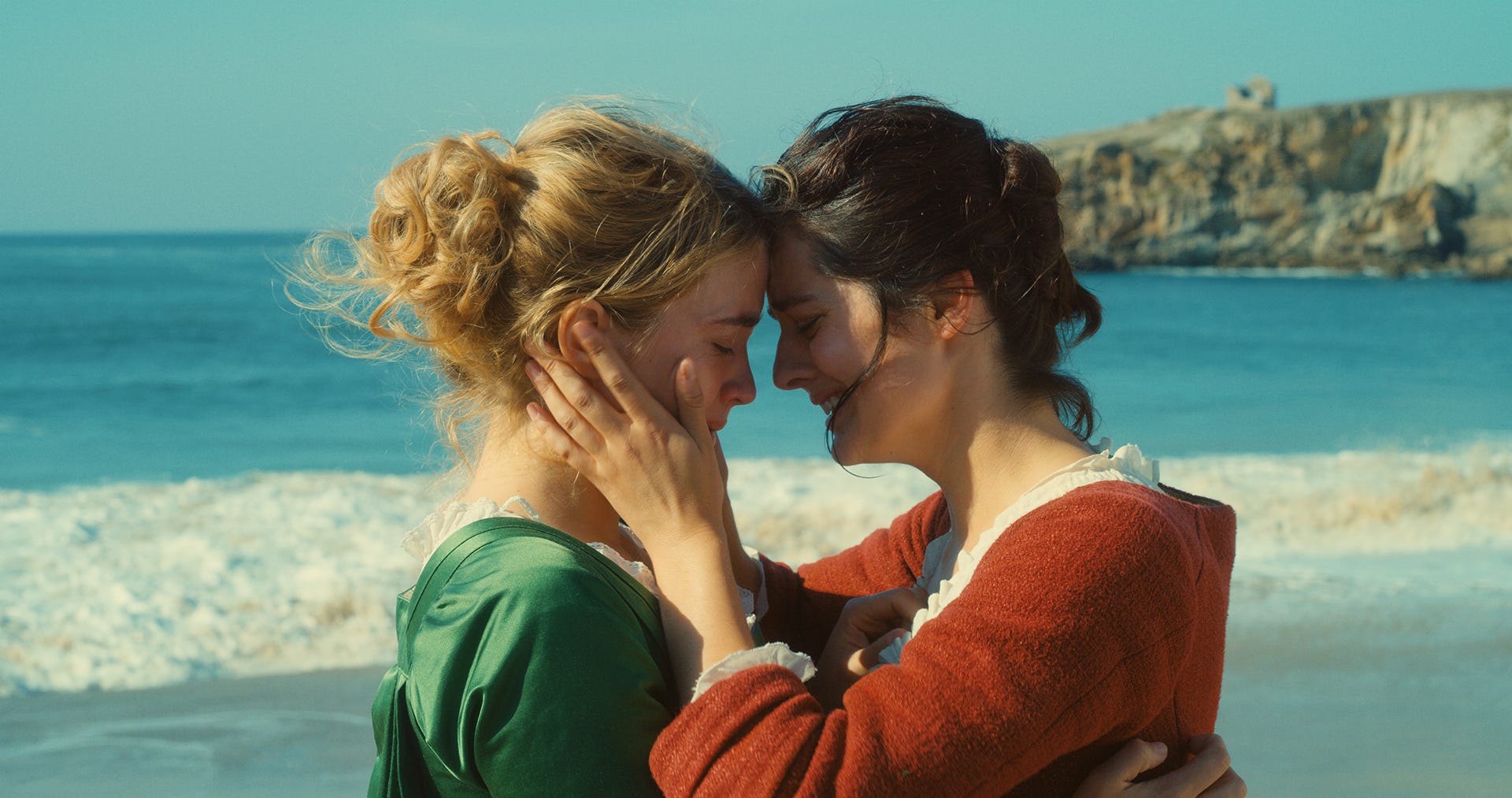
The film’s color palette feels carefully curated to enhance these emotional beats. Green, red, and blue appear against one another, their vibrancy amplifying the intensity of the moments. One memorable example is the beach scene, when they’re painfully aware that their time together is ending. The contrast of red and green in that scene feels deeply satisfying, visually rich, and emotionally charged.
White, too, plays a significant role. Marianne seems to be haunted by an image of Heloïse dressed in white. Although we sort of know that it is her in a wedding dress, it seems like we see her death. It is a ghostly image. Later on we see Heloïse in that exact wedding dress, a gift from her mother, before Marianne leaves forever. That moment, with Heloïse in white, signals the end. It’s when she says, “Turn around,” asking Marianne for one last look, one final memory, echoing their earlier conversation about Orpheus and Eurydice. The heartbreaking goodbye.
The abortion scene
Some might see the abortion scene as tangential, a side note on the broader theme of women’s oppression. But I think it goes much deeper than that. Early on, we see Heloïse urge Marianne not to look away during the procedure, even as Marianne instinctively tries to. Heloïse wants her to witness it fully for what it is. She knows there’s meaning in confronting it, in seeing the pain and the truth of it without flinching.
Later, Heloïse suggests it be painted. It’s not enough to just witness it, they want to document it. This, too, is the reality of womanhood. Abortion is hidden, unspoken. But here, they choose to do something radical: make it visible. Not as a sanitized or symbolic gesture, but as an honest portrayal. It stands in stark contrast to the idealized portraits Marianne typically paints. This scene is a raw expression of reality, still fresh in their memory. A woman, undressed, in pain. It’s intimate, vulnerable, and secret, yet it’s also profoundly powerful.
There’s no beauty in it in the way men might prefer to see beauty, but there is beauty in the act of expression. In turning pain into art. In claiming space on a canvas for what women have always been told to hide.
The glances, looks and gazes
Now, the best part for last. Though it’s less about analysis and more about what you feel through the screen. From the very beginning, we see how absurd and suffocating the expectations placed on women are. Marianne climbing a rocky cliff in a heavy dress says it all, it’s an image of constraint, of forced decorum in a world that doesn’t accommodate women’s freedom.
But as soon as the clothes come off, something shifts. When Marianne is first shown naked, seated in front of the fire, there’s no shame or spectacle, just a quiet comfort in her own skin.
That moment signals a deeper liberation, and as her relationship with Heloïse unfolds, the absence of clothing becomes symbolic. Not sexualized, but humanizing. We see them lounging freely, bare and at ease, physically and emotionally. It’s a shedding of performance, of societal roles, of everything that’s expected of them.
And then there are the glances. This film is built on them. A single look carries more weight than pages of dialogue. From the very first gaze, something unspoken begins to pass between Marianne and Heloïse. Desire, curiosity, defiance, vulnerability - it’s all there in the eyes. Their silences speak louder than words, the stillness between them filled with tension, intimacy, and longing.
Every gaze feels like a turning point. They fall in love not through grand declarations, but through slow, deliberate observation. They see each other. Really see each other. In a world that constantly tells women who they should be, these two women quietly choose to witness each other as they are.
And of course, it all comes full circle in that final look. Heloïse tells Marianne to turn around, echoing the Orpheus and Eurydice myth they discussed earlier. That last glance is their final memory, something to hold onto in the absence of presence. It’s both an ending and a preservation. The way they loved each other was through seeing and being seen. And in the end, that’s what remains. The last time Marianne sees Heloïse is at the theater where she finally hears the music from start to finish. Certainly, a scene that would bring up some tears.
