

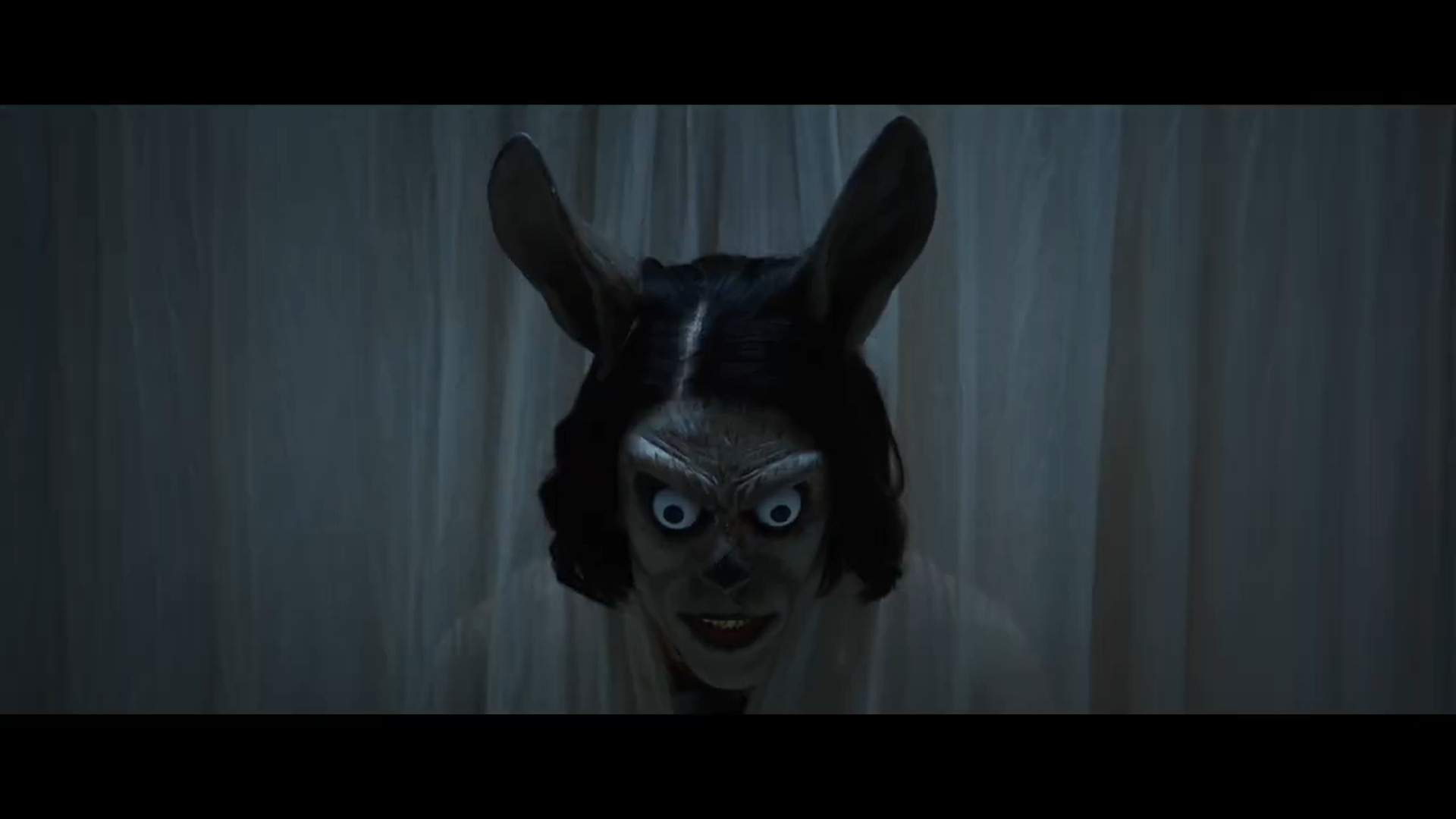
Writer Ohm Bauman goes to The Bilberry Woods Hotel in rural Ireland to scatter his parents’ ashes. After a girl he meets goes missing, he searches the hotel, where he learns that the building and the people it inhabits hold deep, sinister secrets. Directed by Damian McCarthy of Oddity (2024) and Caveat (2020) and starring Adam Scott of Parks and Recreation and Severance, Hokum continues in McCarthy’s work of proving there is nothing more sinister than the deepest pit of blackness inside of man.
Like Oddity and Caveat, McCarthy seeks to display that seemingly ordinary people can harbor true evil within themselves, while using witches, ghosts, and possessed golems as the boogeymen as representations of those evils. I see these three as an unofficial trilogy in that sense, all working together to strengthen that central idea. All three isolate their protagonist in rural Ireland, all three depict a violent crime against women, and all three use supernatural entities to personify the evil of those crimes.
The use of the supernatural is fascinating to me, as in each case, I often found myself wondering if the hauntings were a hoax. To me, paranormality works in two ways: a person can be haunted, and an environment can be haunted. A person being haunted usually harkens back to a past traumatic event that protagonists have to come to peace with and grow from. Here, Ohm is haunted by the ghost of his mother, who died from a gunshot when he was young. He carries the guilt of her death with him as he sees her ghost throughout the film. The environment being haunted can relate to several things, but here, it serves as a personification of evil. Without spoiling the ending of the movie, the witch that haunts the hotel chains Ohm and another man up, and only one of them is dragged to the underworld.
With so much of the film taking place in the hotel, and in particular, one room of the hotel, McCarthy makes the most of his space. Countless shots follow Ohm traversing the room, and we are peeking at the background, trying to see if there is something out of the ordinary. While a lot of the jumpscares ended up being telegraphed in a way like this, I still found them to be quite effective, with some getting physical reactions out of me. Beyond the jumpscares, the atmosphere is incredibly tense, especially as the movie hits its second act. Once Ohm returns to the hotel to look for the missing woman, Fiona, the movie fully clicks into gear. The movie is dark, and it utilizes its negative space well, making you never feel safe in a scene until the next one starts, only to start that cycle all over again.
I’d be remiss not to talk about how well Adam Scott works in Hokum. His bitter, cynical Ohm carries a lot of trauma with him, which influences his cynical work as a writer. What I found particularly interesting is how well adept Scott is at burying his trauma, only opening up after a few drinks. He’s abrasive, which is off-putting at times, but it makes his quest to find the missing Fiona all the more believable as he goes against all conventional wisdom to find her truth. His performance is nuanced and emotive, which effectively drives the story and heightens the fear.
Concluding Thoughts
Hokum is tense and frightening, making great use of its rural setting, and focuses on isolation. Damian McCarthy crafts a terrifying mystery, again showcasing the depths of evil. He is quickly becoming one of my favorite rising voices in the genre. Adam Scott delivers an incredibly nuanced and rich performance as Ohm. If you haven’t seen it already, make Hokum a priority watch.